Tell us about the job
Takes about a minute. No obligation.
A mini-split compressor starting and stopping through a long cooling season puts the most stress on the parts that handle each cycle: the contactor, the capacitor, and the refrigerant circuit. Homes in Sumter County, SC run cooling about five months a year, from May through September. By the time a homeowner notices something wrong, a contractor repairing the unit is often tracing a fault that built slowly across multiple seasons of hard use. Worn contactors and low refrigerant charge rarely announce themselves until the system is pushed on the hottest days, which is exactly when a sluggish response or a hard shutdown finally surfaces.
Mini-split systems installed in older houses carry a repair history shaped by what those houses were built to do. Half the homes in Sumter County, South Carolina were built in 1987 or earlier (2020-2024 ACS 5-year). That housing was built around cooling equipment with different coil pressures and different duty cycles than a mini-split runs. When a contractor opens a unit here, the wear pattern on the compressor and the condition of the refrigerant circuit reflect years of demand the original construction never anticipated. Parts that look like a straightforward swap sometimes turn out to be specific to an older production run, and a contractor has to confirm availability before the repair scope is final.
The Parts of a Mini-split a Contractor Checks First
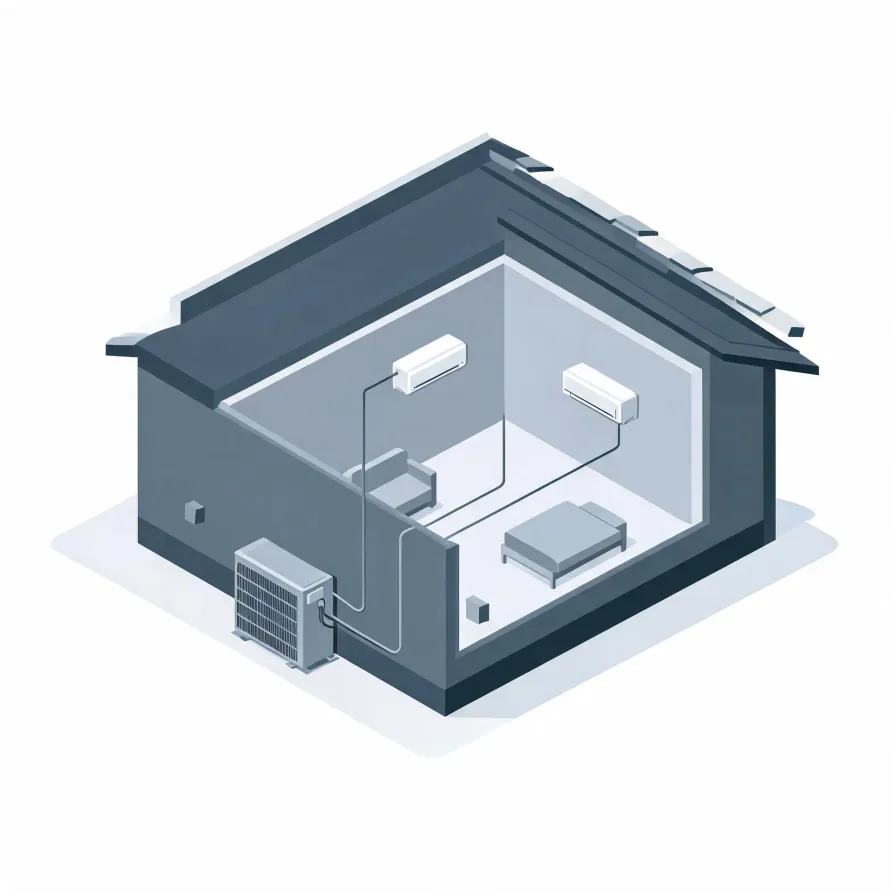
The indoor air handler mounts high on a wall inside the room and is where most visible problems show up first: a frozen coil, a clogged drain line, or a fan that has stopped moving air. The outdoor condenser unit sits outside the house and houses the compressor, which is the component contractors look at when the system runs but produces no change in temperature.
A refrigerant line set runs between the two units through a small penetration in the wall, carrying the refrigerant that makes the whole system work. A condensate drain line runs from the indoor unit to the outside, and a blockage there is a frequent cause of water leaking into the room.
The drawing shows the general layout of a mini-split system, and a licensed contractor determines which components and conditions apply to your specific installation.
Get matched in Sumter CountySumter County, by the numbers
235 severe weather events were recorded in Sumter County, South Carolina between 2015 and 2024.
NOAA National Centers for Environmental Information, Storm Events Database, bulk CSV export, events 2015-01-01 through 2024-12-31.Half the homes in Sumter County, South Carolina were built in 1987 or earlier (2020-2024 ACS 5-year).
U.S. Census Bureau, 2020-2024 American Community Survey 5-Year EstimatesSumter County, South Carolina holds 47,582 housing units (2020-2024 ACS 5-year).
U.S. Census Bureau, 2020-2024 American Community Survey 5-Year EstimatesOwners occupy 68.1% of the occupied homes in Sumter County, South Carolina (2020-2024 ACS 5-year).
U.S. Census Bureau, 2020-2024 American Community Survey 5-Year EstimatesCodes & Standards Covering Mini-Split Repair in Sumter County, South Carolina1 sourced rules and standards
Licensing Rules for HVAC Repair in Sumter County, South Carolina
South Carolina requires a mechanical contractor license for contracting work whose total cost of construction is greater than ten thousand dollars.
Severe Weather Events in Sumter County
Weather puts real hours on heating and cooling equipment. How hard a mini-split works, and how often it needs attention, is shaped by what the local climate demands of it.
235 severe weather events, 2015–2024. Source: NOAA National Centers for Environmental Information, Storm Events Database.