Profile view of a bearded man wearing a dark green baseball cap and a dark gray T-shirt against a plain light background.

Why your mini split won't turn on in a South Carolina winter

Step 1 of 3: Equipment

Why won't my mini split turn on this winter?

Cold snaps here are the real test for a mini split. If yours was running fine last week and now the indoor unit is dead or just blinking at you, the first instinct is to check the breaker and the remote batteries. When that doesn't fix it, something in the system itself has stopped it from starting.

Most likely a frozen or iced-up outdoor unit, or a safety lockout

When a mini split won't start in cold weather, the outdoor unit is usually the problem, not the one inside. If ice has built up on the coil or the fan is frozen in place, the system's controls will stop it from running rather than let it keep trying. South Carolina winters don't stay cold for long, but the nights that do drop near freezing are enough to cause this, especially after rain or heavy dew freezes overnight. Since most homes here rely on electric heat including the mini split itself, a unit that won't start isn't a minor inconvenience. A blinking light on the indoor head is usually the system telling you which fault it tripped on.

A white wall-mounted mini-split air conditioner installed high on a beige interior wall near the ceiling, with a white-framed window at the left edge.

Running clean

This is what a mini split should look like after a filter wash and a quick look at the coil and drain line. Air moves through it without fighting dust or grime. In a South Carolina winter, that clean path is what lets the unit cycle on without tripping a sensor or icing up.


A dusty, stained wall-mounted mini-split air conditioner indoor unit near the ceiling on a plain beige wall, with visible lint buildup at its intake grille.

Choked with grime

Dust and dark buildup like this across the casing and filter block airflow before you ever hit a cold morning. The unit works harder to push heat through, strains the parts that start it, and is a common reason it won't respond at all when the temperature drops.

Why does my mini split only act up when it's cold out

You might notice the outdoor unit sitting there with frost or ice built up on it, especially after a night in the 20s or 30s. Or the indoor head hums for a second and quits. Maybe the remote shows a temperature setting but nothing blows, or you hear a click from outside and then silence. Some units flash a light in a pattern you've never seen before. None of this shows up in July, which is why it catches people off guard in January. If the outdoor coil stays iced over and the unit keeps trying to start anyway, it strains the compressor, and that's a more expensive problem than the one you have now.

A dim room with a wall-mounted mini-split air conditioner above a faint vertical stain running down the wall, a folded grey towel on the wood floor at the baseboard, and a desk with monitor, lamp, small plant and office chair by a window.

You're at your desk working from home, mid-afternoon, and you notice the wall under the indoor unit looks wrong. A streak, dark and wet, running down from the bottom edge of the unit toward the baseboard. You get up and put a hand on it. Damp. There's already a faint ring on the carpet where it's been dripping for a while before you looked up from your screen. You grab a towel from the bathroom and lay it down, then stand there looking at the unit, the vents, the seam where it meets the wall, trying to figure out where the water is actually coming from.

Hand off the mini split problem

Describe your mini split job once, to one pro.

There's no charge for the request.

Most mini splits rated for cold climates can pull heat from outdoor air down to around 5 degrees Fahrenheit, sometimes lower. Below that, the system has to work harder to find any heat to move inside.

That's why a unit that heated your house fine in December can stall out during the coldest week of January. The equipment isn't broken just because the cold finally caught up to it.

A smiling man in a gray long-sleeved shirt stands in a kitchen looking to the side, with open shelves of dishes, a white mug on the counter, a potted plant, and a view through a doorway into a living room.
A smiling bearded man in a green sweater sits at a white marble kitchen island with a mug, potted plant and bowl of fruit, in a bright white interior with open shelving and an arched doorway.
A smiling man with dark curly hair and a beard, wearing a dark green knit sweater, stands at a white marble kitchen counter with a dark blue mug, with open shelving, pendant lights and a houseplant behind him.
A smiling man in a green ribbed sweater stands behind a wooden table holding a ceramic mug of coffee in a kitchen with white subway tile, shelves of potted plants, and a bowl of fruit.

Call a repair tech first

A mini split that won't turn on in the cold is doing something a breaker reset usually can't fix. Frost on the outdoor coil, a defrost cycle stuck partway, a drain line frozen shut, a control board that's lost track of the outdoor sensor. These need someone who can open the unit and see what's actually happening with the refrigerant charge and the sensors, not just flip switches. If you've already checked the breaker and the batteries in the remote and it's still dead, that's the signal to stop guessing. A tech can tell you in one visit whether it's a sensor, a board, or ice that built up faster than the defrost cycle could clear it, and get it running again before the next cold night.

Try the simple stuff yourself

Some mornings the fix really is small. Check that the breaker didn't trip overnight, especially if the heat ran hard through a cold snap. Look at the outdoor unit for a light dusting of frost, which is normal, versus a thick coat of ice, which isn't. Pull the remote batteries and reseat them. Clear leaves or anything blocking the outdoor unit's airflow. None of this takes long, and it rules out the easy causes before you spend money on a visit. But if the breaker's fine, the remote works, and the unit still won't respond or the outdoor fan won't spin, you've done what you can from the outside.

A white wall-mounted mini-split air conditioner indoor unit installed near a textured ceiling on a plain beige wall, with visible dust and discoloration on its casing and vent.
Before you get your mini split repair
A white wall-mounted mini-split air conditioner indoor unit on a light gray wall above a white baseboard and wood-look floor.
After you get your mini split repair
A white wall-mounted mini-split air conditioner installed near the ceiling on a beige interior wall, with a window and bamboo blind at the left edge showing green foliage outside.

Running clean

Air moves through the vents without resistance. The coil and drain line stay clear, so the unit draws power, hits its set temperature, and cycles off like it should. Nothing on the panel is fighting the airflow.

A wall-mounted mini-split air conditioner indoor unit with discolored casing and dusty vents, installed near the ceiling on a plain light-colored wall.

Choked with dust

Grime on the louvers and front panel means the unit is pulling air through buildup, not past it. That strain adds up, and in a hard freeze it can be enough to keep the system from starting at all.

A man in a blue T-shirt sits on a light gray sofa, laughing while looking at an open laptop in the foreground, with a framed picture, lamp and potted plant behind him.
A bearded man in a blue and brown plaid flannel shirt stands indoors looking out a window at snow-covered trees, with a ceramic mug on the windowsill.

Fixing it yourself

You crack the cover, check the filter, reset the breaker again. If the outdoor coil is frosted or the defrost cycle is stuck, none of that brings it back on.

Fill out one form

Getting a repair tech out

No more calling around or explaining the blinking light twice. Send the form and the search for someone qualified is off your plate.

Fill out one form

Power costs 15.12 cents per kilowatt-hour statewide

Electricity here runs 15.12 cents a kilowatt-hour. Heat pulled from a mini split still costs less to run than baseboard or strip heat, so a unit stuck blinking instead of heating is costing you comfort, not just a spot on the power bill.

EIA-861 2025 statewide residential average

  1. Outdoor temperature drops and frost starts forming on the outdoor coil.

  2. The system senses the frost and switches into defrost mode.

  3. A reversing valve redirects hot refrigerant to melt the ice outside.

  4. The indoor fan shuts off so it won't blow cold air at you.

A mini split that won't turn on in a South Carolina cold snap is almost always stuck on frost, a defrost cycle, or a frozen drain line, not a tripped breaker. Resetting the power might bring the panel back to life for a minute, but it won't clear ice off the outdoor coil or get a stuck control board talking to the outdoor unit again. That takes someone who can look at the coil, the drain line, and the defrost cycle and tell you which one quit. Once you send the form, you're done hunting through listings, calling shops to ask if they even work on mini splits, and repeating the same description of the blinking light to each one. A repair tech who already knows this equipment gets matched to you, and the rest of the work, the kind that eats an afternoon before anyone's even looked at your unit, is off your plate. Your house still needs heat. Getting the right person looking at it is the part you no longer have to manage yourself.

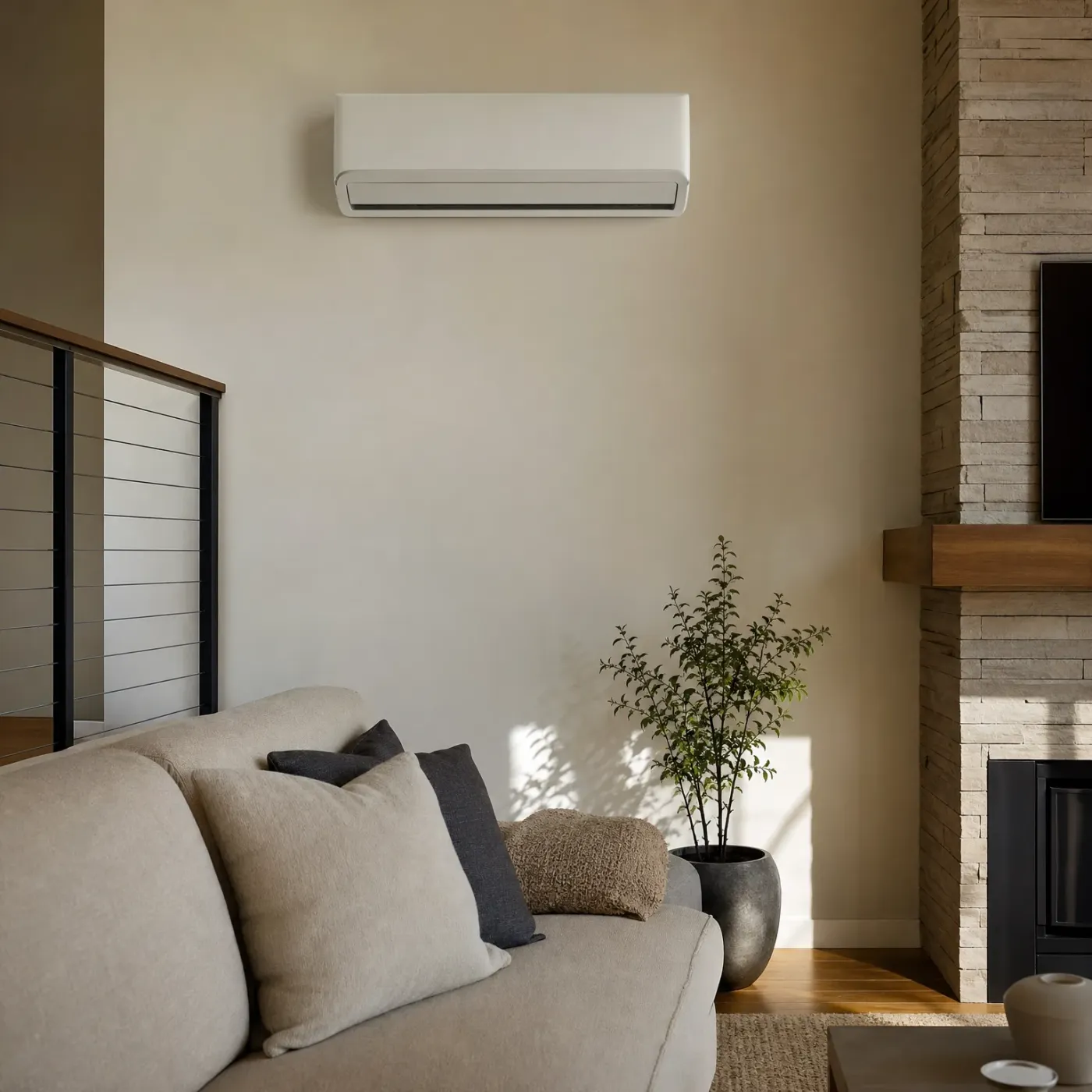
Interior living room with a white wall-mounted mini-split air conditioner high on a beige wall, a light gray sofa with cushions, a potted small tree, a stacked-stone fireplace with wood mantel and mounted TV, and a cable railing at left.

Stop chasing a mini split pro

Skip the search

Explain the job once and skip repeating it on every call.

Asking costs nothing, and the choice to hire stays yours.