Why your mini split leaks water in a South Carolina winter
Skip searching for a mini split pro and answer a few questions instead.
A mini split dripping water in the middle of winter catches most people off guard. You expect that in July when it's working hard against the heat, not in January when it's heating the room. But a mini split heating your house in a South Carolina winter can still leak, and the cause is usually something specific to how the unit is running right now, not left over from summer.
Most of the water that shows up comes from the condensate drain line or the drain pan inside the indoor unit. When the system heats, moisture still collects on the coil, and that water has to go somewhere. If the line is clogged, pitched wrong, or the pan has cracked or shifted, the water finds the nearest way out, which is usually down your wall or across your floor.
Figuring out which of those it is isn't something you can tell from looking at the unit on the wall. It means pulling the cover, checking the pan, running water through the line to see where it backs up. That's a job for someone who works on this equipment regularly, not a guess made from a ladder.
Finding that person is usually the slow part. You'd be looking up HVAC companies, calling a few, describing the leak and the unit to each one, then waiting on quotes to compare before you even get someone out to look at it. This page skips that. Tell it what's happening and it connects you with one licensed contractor near you in South Carolina, someone who services mini splits through the winter and knows what usually causes this. No stack of calls to return, no juggling different estimates for the same drip.
From there, the fix is in their hands. What's below will walk through the usual reasons a mini split leaks in winter here, so you know what they're likely to find.
A mini split that drips water while it's heating usually comes down to condensation on the indoor coil, the same way a cold glass sweats on a humid day. In heating mode, the coil itself runs cooler than the room air around it for short stretches, especially during defrost cycles, and that pulls moisture out of the air onto the coil. Normally that water drains out through the condensate line and away from the unit. If it's showing up inside instead, the drain line is likely clogged, disconnected, or pitched wrong, or the pan underneath has cracked or filled up. It can also mean the line froze somewhere outside. None of this fixes itself. Left alone, it keeps dripping onto your floor or wall, and the water sitting in the unit can lead to rust or mold inside the housing. The fix depends on finding exactly where the water is getting past the drain, which means someone needs to open the unit and look.
Before you get your mini split repairAfter you get your mini split repair
Why the drain line matters
That condensation has to go somewhere. Indoor units carry a small drain pan under the coil and a condensate line that routes the water outside. If that line has a kink, a clog, or the wrong slope, water backs up into the pan and spills over instead of draining. A line that handled summer runoff fine can still cause trouble in winter if dust, algae, or a pinched section narrows it further. The coil doesn't need to be producing much water for a blocked drain to overflow. A contractor checks this line first, since it's one of the simplest things to test and clear.
What a frozen coil does
If refrigerant charge is low or airflow across the coil is restricted, the coil can drop below freezing even while the unit is heating the room. Ice builds up on the coil itself, and when the system cycles or defrosts, that ice melts all at once. More water shows up than the drain pan and line were built to carry in one go, so it overflows onto the floor or wall below the indoor unit. A dirty filter or blocked intake can bring this on just as easily as a refrigerant issue, so a technician checks airflow before anything else.
What's Actually Happening Inside the Unit
The indoor unit's coil sits inside a slanted drain pan built to tip water toward the drain line, not just catch it.
Mini splits in heat mode still run short defrost cycles that melt frost off the outdoor coil, and that water has to drain somewhere too.
A clogged air filter slows airflow across the indoor coil, making it run colder and sweat more than it should.
An indoor unit mounted slightly off level, even by a few degrees, can send water toward the wall instead of the drain pan.
The condensate pump, if your unit has one, moves water uphill to the drain line and fails silently when it clogs.
Algae and dust build up inside the drain line itself over time, narrowing the path water has to travel to get outside.
The indoor unit is built around that slanted pan for a reason. Gravity is doing the work, so anything that changes the angle or blocks the path gives water somewhere else to go. Start with the pan itself. It sits under the coil at a slight pitch toward the drain line, and that pitch only works if the unit was mounted level to begin with. A mount that's shifted even a little sends water walking toward the wall mount or the casing seams instead.
Heat mode adds a step people don't expect. The outdoor unit frosts up in cold weather and runs brief defrost cycles to clear it, and the water from that melt has to find its way out through the same drainage system as the indoor condensation. If that system is already struggling, the defrost water is what tips it into a visible drip.
Airflow matters more than most people think. A dirty filter chokes the air moving across the coil, the coil runs colder than it should, and colder metal pulls more moisture out of the air than a clean system would. From there it's about whether the water can leave. Some units push condensate out by gravity alone. Others rely on a small condensate pump to lift it to the drain line, and that pump fails without warning. Either way, algae and dust build up inside the line itself over months, narrowing it until water backs up faster than it can drain.
No phone calls to make
Only one pro gets your request, so you hear from one company.
One form replaces the calls you'd make to find a mini split pro.
Why does my mini split only leak water in heating mode, not cooling?
It seems backward. Summer is when you'd expect condensation, with the muggy air outside and the unit running constantly. Instead the leak only shows up once the weather turns and the mini split switches to heat. That pattern isn't random. It points to something specific about what the indoor coil is doing in heating mode that it doesn't do in cooling mode.
The coil picks up moisture from defrost cycles, not from cooling the room
In cooling mode, the indoor coil stays cold the whole time it runs, so condensation forms steadily and the drain line carries it off at a steady pace. In heating mode, the outdoor unit periodically runs a defrost cycle to melt frost off its own coil, and that meltwater has to go somewhere too. If the indoor drain pan or line is already partly blocked, cooling season might drain it fine while the slower, uneven flow from heating mode sits long enough to overflow the pan. That's why a unit can run clean all summer in South Carolina's humidity and still drip the first cold week of winter.
South Carolina summers run humid, and the dew point averages 69°F across June, July and August, according to NOAA. That's the number that tells you how much moisture your mini split pulls out of the air every time it runs. All that condensation trains the drain pan and drain line to handle a steady, heavy flow for months at a time. Come winter, the unit asks much less of that same pan and line, since there's far less moisture to shed. If a clog or a bad slope has been building quietly since summer, you might not notice until heating season, when a slower trickle finds the one spot where water has nowhere to go but down through the unit and onto your floor or wall.
NASA POWER T2MDEW county cells weighted by homes
What are you noticing in the room right now
A damp patch on the wall under the indoor unit, or water spotting the floor or the windowsill below it. Sometimes it's a slow drip you can hear when the room is quiet. Sometimes the unit's housing itself feels wet along the bottom edge. You might smell something musty near it if the water's been sitting a while, soaking into drywall or trim instead of running off. None of that is normal for a mini split in heating mode. Left alone, that moisture doesn't just stain. It can soften drywall, warp flooring, and give mold a damp corner to start in, right where your family spends the winter.
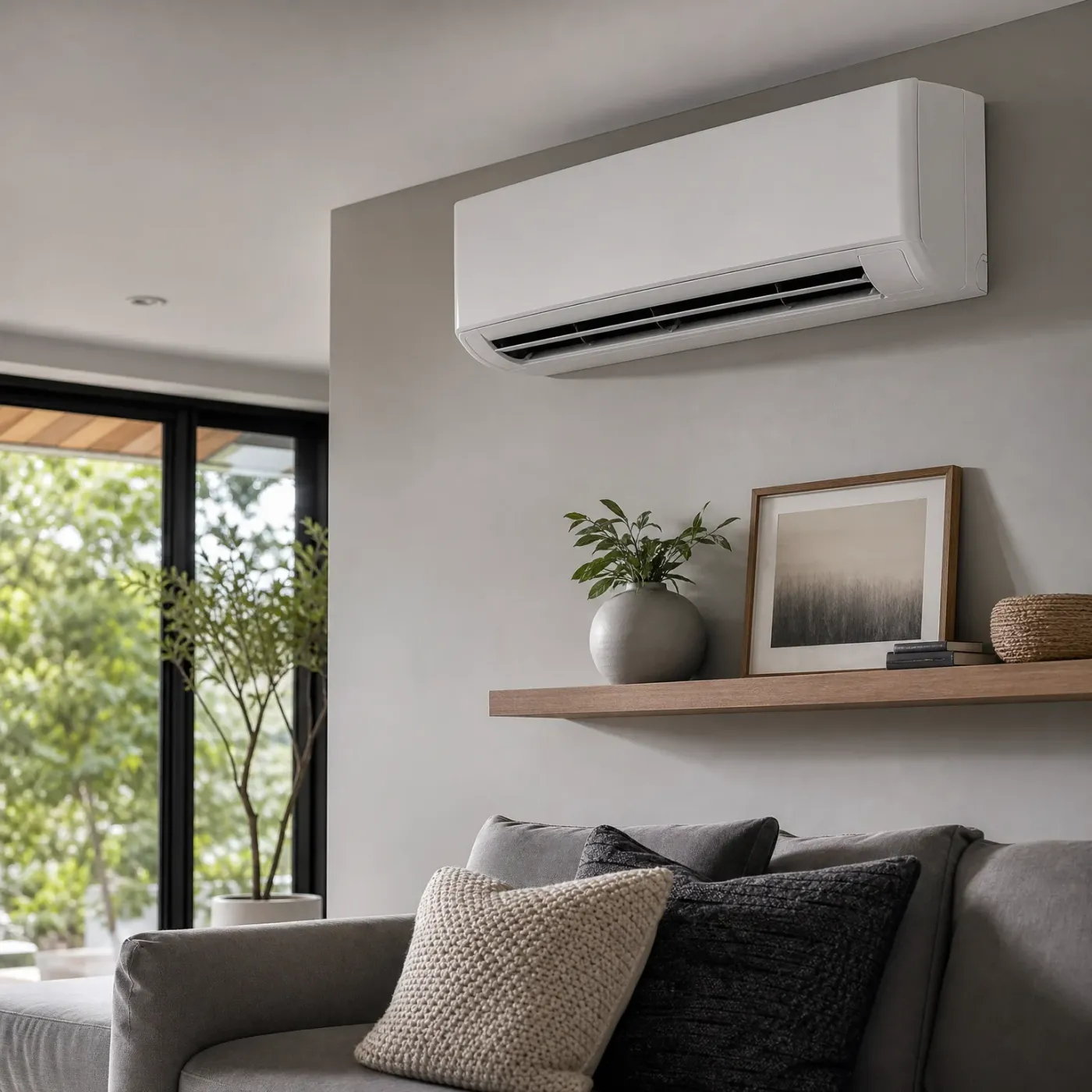
A mini split like this is draining the way it should, with condensation routed outside and nothing left behind on the coil or the pan.
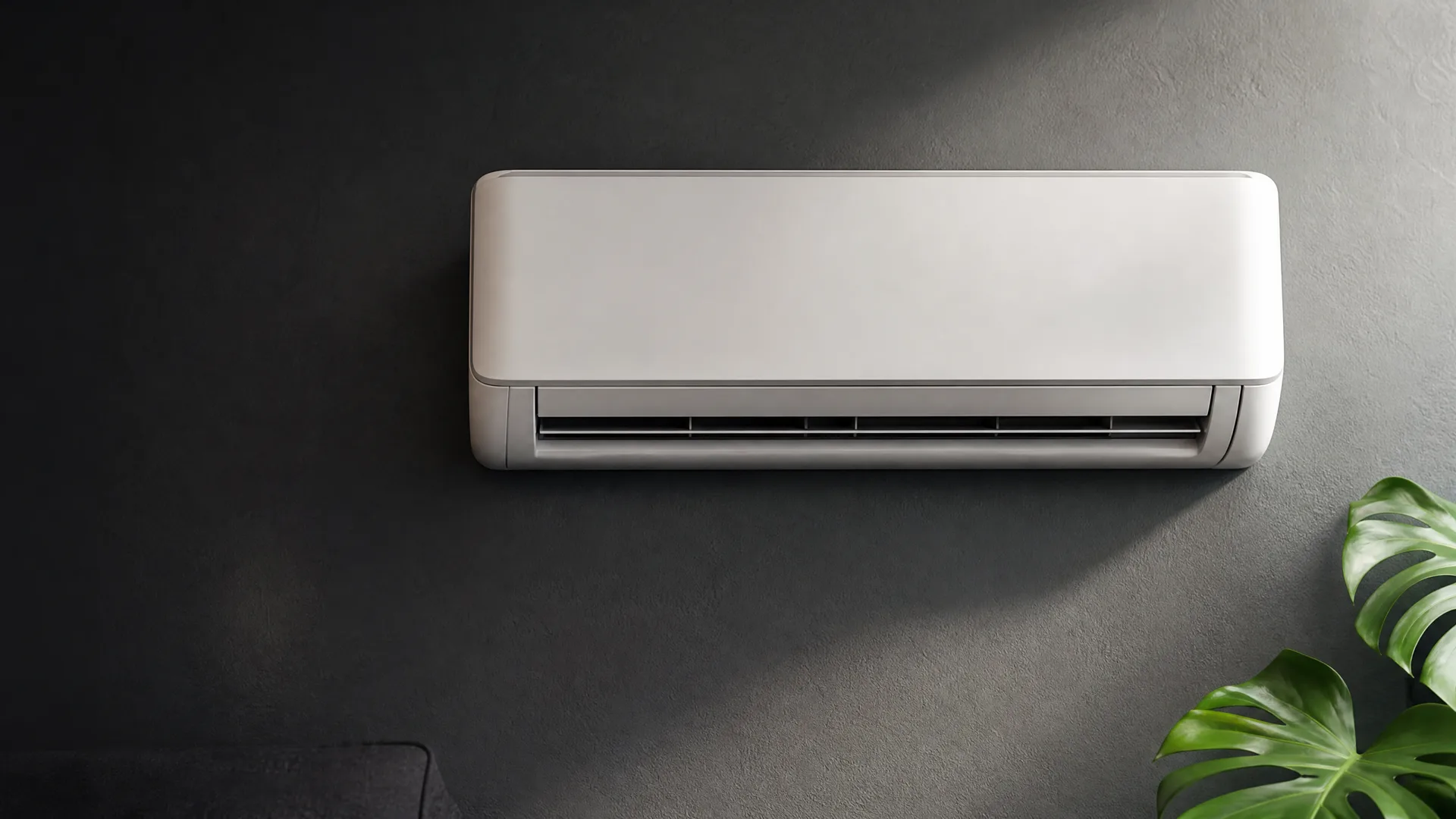
Dust and buildup like this on the coil and louvers slow the drain path, so water misses the pan and ends up on your wall or floor instead.
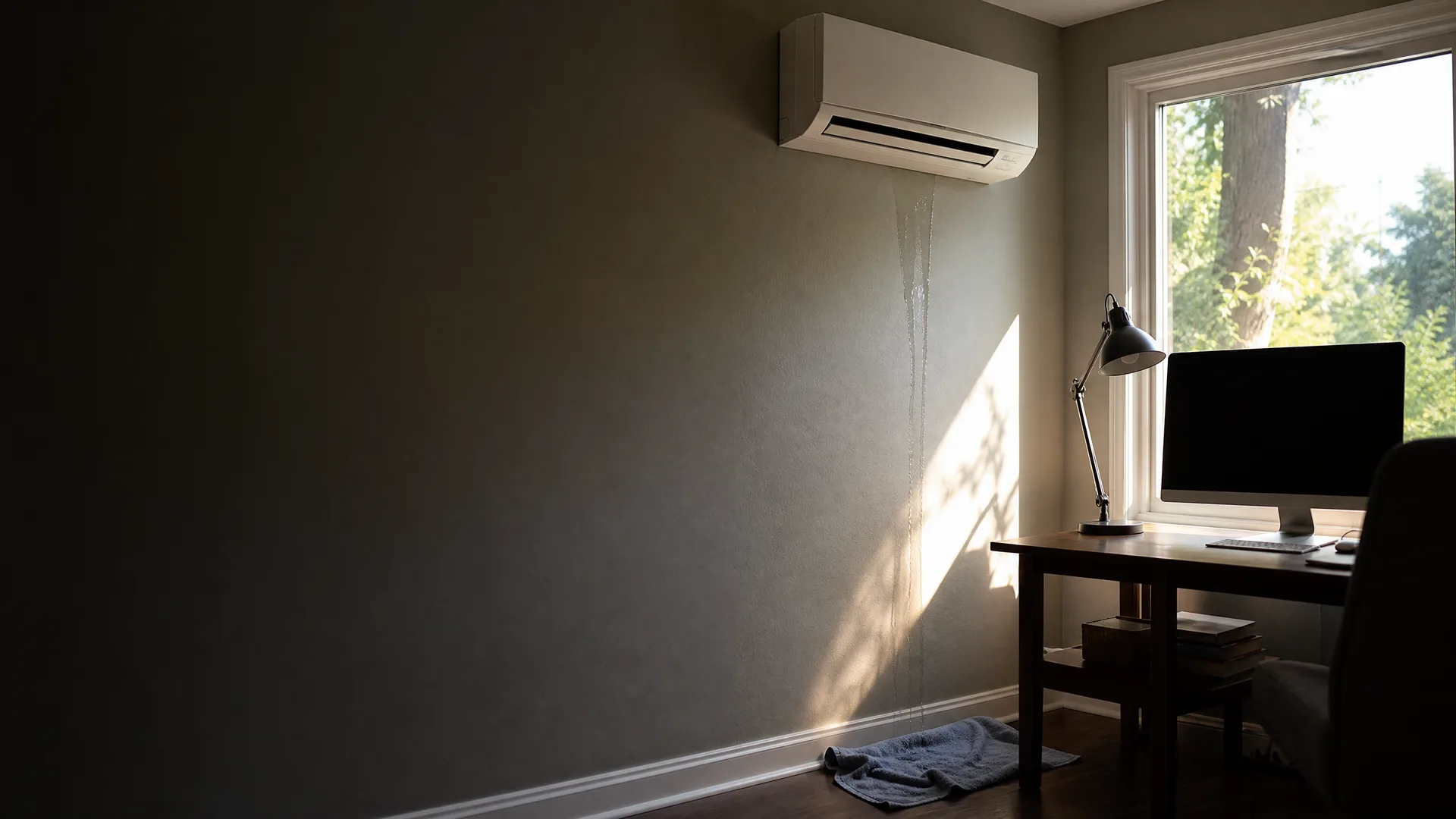
It's gone three in the afternoon in January and you're at the desk in your home office, the mini split above you ticking along, warm air coming down. You catch movement out of the corner of your eye, a streak on the wall under the unit, already a foot long and still spreading. You get up, press a finger to it. Wet, and cold. You grab a towel from the hall bath and lay it along the baseboard, then stand back and watch the wall to see if the streak keeps growing while the unit keeps running like nothing's wrong.
Power costs 15.12 cents per kilowatt-hour statewide
At 15.12 cents a kilowatt-hour, running your mini split's heat all winter to chase a leak instead of fixing the drain line adds up for no reason. A clogged line doesn't just leave water on your wall, it can make the unit work harder than it should to heat the room.
EIA-861 2025 statewide residential average
Clean coil, clear path
This is a mini split draining the way it was built to. The coil stays clear behind the louvers, so condensation runs down into the pan and out the line, not down your wall. Nothing to see here but warm air coming down.
Grime like this slows the drain
Dust and buildup coat the coil and louvers, and that film changes how water moves across them. Instead of sheeting down into the pan, water clings and misses the edge. That's how it ends up on your wall instead of outside.
A leak like this has a cause, and it's fixable
Water on the wall under your mini split in January almost always traces back to the drain line or the coil behind the louvers. Something is blocking the path that condensation is supposed to take out of the house, so it ends up on your wall or windowsill instead. That's a repair, not a reason to shut the unit off for the rest of winter.
Finding who to call about it is its own chore. You'd normally be searching for someone who works on mini splits, explaining the leak over the phone to two or three companies, then sitting on quotes trying to tell them apart. A licensed contractor local to South Carolina who services this equipment all season already knows what a heating-mode leak usually means before they walk in, so you're describing the problem once, to one person, not fielding calls from several.